
Cancer
Organizations Focused on Canine Cancer
Colorado State University has estimated that 1 in 4 dogs, on average, will develop cancer in their lifetime. Some cancers are more common than others, some are more lethal; fortunately, there can be good quality of life or even cure after treatment. Canine cancer research programs have devoted many millions of dollars toward improving diagnosis and treatment of some cancers; AKC CKF alone has already invested more than $4.8 million on hemangiosarcoma. Other AKC CHF grants are about general cancer, osteosarcoma, hemangiosarcoma, and lymphoma. MAF ongoing research grants cover, hemangiosarcoma, osteosarcoma, improving well-being on chemotherapy, soft tissue sarcoma and more
The Animal Cancer Foundation has The Canine Cancer Genome Project (CCGP) modeled after The Cancer Genome Atlas (TCGA) and sponsored by a generous inaugural gift from Blue Buffalo Foundation. The project will map the tumor genomes of the seven most common canine cancers and place the datasets in the public domain for use by all veterinary and human cancer researchers, enhancing the ability to compare cancer genomics in both pets and people to find cures for all.
There is statistical evidence that genetic characteristics can contribute to higher rates of cancer, although more research is needed to better understand which genetic factors are involved. This increased risk may be caused by either a combination of genes or a single gene. Golden Retrievers, Boxers, Bernese Mountain Dogs, German Shepherds and Rottweilers are generally more likely to develop specific types of cancer than other breeds. In the Bernese Mountain Dogs mast cell cancer and histiocytic sarcoma are inherited, though the mechanism is not yet clear. Other specific examples include the high incidence of Osteosarcomas (bone cancers) in long-limbed breeds like Irish Wolfhounds, Great Danes, and Scottish Deerhounds in support of genetic factors. In those three breeds, the shared genetic heritage that gives these dogs their graceful legs may also give them a shared predisposition to cancer.
The future holds possibilities for research that may provide for earlier diagnosis, understanding of factors related to development of cancer, and a range of new therapeutic modalities
BeaCon's Registry Cancer Data - 2024
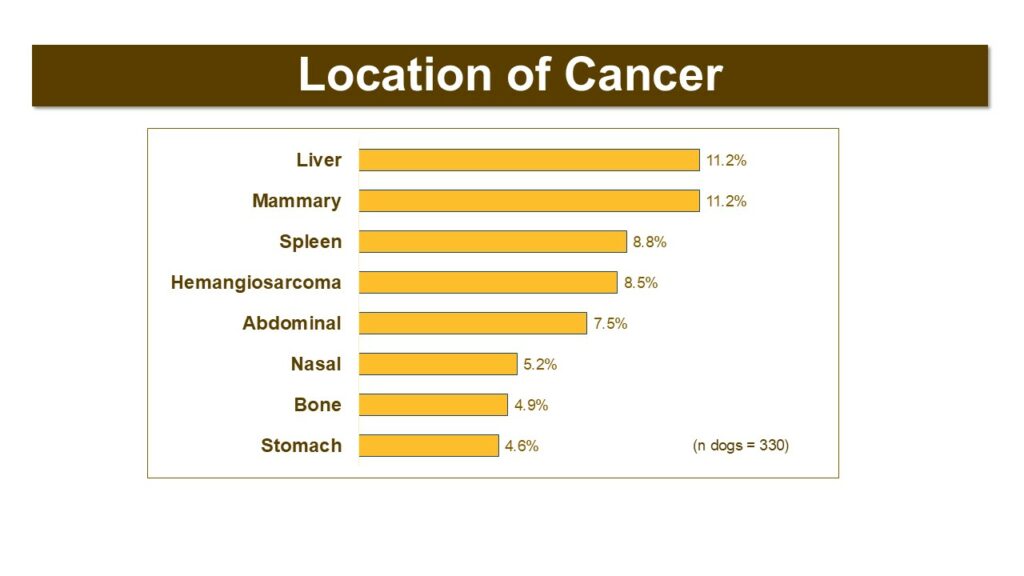
In January 2025 the registry had 3513 Beardies. Cancer had been diagnosed or strongly suspected clinically enough in 330 (9.4% of the total) dogs for the veterinarian to say cancer had caused death. There were a 353 cancer diagnoses in those dogs. All cancers combined were listed as cause of death in 87% of deceased dogs after the age of eight years. The incidence of individual types of cancer is impossible to know because of incomplete evaluations for various reasons. Additionally the autopsy rate was very low and the possibility of metastatic disease with the original site no identified adds to the difficulty. Though inexact, the data available for location (not necessarily specific diagnosis) of a cancer is shown below.
UK Anonymous Survey - 2024
Among the 1147 participating dogs, 41 were reported as having a tumor diagnosis for an incidence of 3.6%. Of those, 16 (1.4% of the total population and 39% of tumor cases) reported having a splenic tumor.